Persian Rug: a paradise at your feet
February 3rd, 2010
Being Iranian, I am fascinated by Persian rugs and the exquisite uniqueness that defines them. The art of carpet weaving in Iran is deeply connected with the culture and the customs of the country.
Being away from California, surrounded by snow in Switzerland and far from my natural “soft fascinations” (read flowers, sunshine, rustling trees) I am experiencing a funny sense of “ecoanxiety” that may be cured by writing about my favorite permanent garden: the Persian Rug…
The designs (naghsheh or cartoon—a grid on paper with spaces colored to guide rug weavers in selecting pile yarns) are still mostly drawn by hand even though computers are doing wonders in this field.
Iranians are literally conceived, born and brought up on Persian rugs! Warmed by their soft and comfortable texture, touching, caressing, lying down and relaxing on them, comes naturally to Persians. The rugs add warmth underfoot like my favorite red carpet with these gorgeous Shah Abbasi patterns (with floral and leaf motifs mainly in the form of lotus blossoms):
The density of tightly woven Persian knots (or guereh) are the calibrating tool for the quality of the rug,
a good Nain rug may have 500 kpsi or 500 knots per square inch (farsibaaf, asymmetric or Persian pile knot.)
This is how a flower looks on the back of this Nain (Na’in):
and the same carpet from the front:
Like most textiles, carpets consist of warps (tar) and wefts (pud). The warps are the threads running the length of the carpet. The wefts are the threads that run across its breadth. This is the same carpet spread out:
Persian rugs go by region (cities mostly— like Tabriz, Esfahan, Nain, Kashan, Kerman, etc…) and each region has its MasterWeaver brand. A small encased signature can usually be found in the minor border like Habibian in Nain, Pirouzian in Tabriz and Taghavi in Bijar.
The most important signature must be Maqsud Kashani’s (from 1540) on the famous pair of Ardabil Carpets. A poem of Hafez is woven into the cartouche:
“Except for thy threshold, there is no refuge for me in all the world.
Except for this door there is no resting place for my head.”
جز آستان توام در جهان پناهی نیست
سر مرا بجز این در حواله گاهی نیست
The Ardabil Carpets have an interesting story: the lower field and border of one of them has been used to restore the other (now in Victoria and Albert Museum in London). The used and abused twin sister was kept in the dark (not to outshine the V&A version) until 1931 and finally found her way to Los Angeles County Museum of Art in 1965.
After exhaustive restoration done to the dazzling beauty, the LACMA sister was finally shown last year (look at how they had to wash it!)
The Ardabil carpets are the world’s oldest dated and historically important carpets in the world. This is the twin sister in Victoria and Albert museum in London:

It all comes down to this fundamental design that I just finished reproducing for the blog:
A love for fine Farsh (rug in persian) may be one of the few things that Shahs and Mullahs have always agreed upon!
Even though I have visited the great Manufacture des Gobelins some years ago,
I am dying to see the real thing in Iran,
and take some great pictures.
I will leave you with this superb painting of my favorite Orientalist painter, Gerôme, called The Carpet Merchant (ca 1887):
A great site to get acquainted with Persian rugs: Farsh Mashad
Weaving Art Museum here
About different motifs and style here
Port-au-Prince: Capital of Pain
January 19th, 2010
ca·lam·i·tiy:
1 : a state of deep distress or misery caused by major misfortune or loss
2 : a disastrous event marked by great loss and lasting distress and suffering
This “bar-coded” child is the symbol of the total helplessness of people in Port-au-Prince.
I am heartbroken by the utter distress/despair of Haiti. So much misery and suffering caused by a few seconds of random natural violence…
“Tout est enfin divisé
Tout se deforme et se perd
Tout se brise et disparait
La mort sans conséquences”
“Everything is finally divided
Everything is deformed and lost
All breaks and disappears
Death without consequences” Eluard
I wonder how Basquiat would have seen all this suffering in his fatherland; he painted some prescient images in 1980’s…
Damon Winter has taken striking pictures of the inconsolable Haiti.
Different shades of white
January 10th, 2010
White is the color of purity, cleanliness, and innocence…or is it? I am surrounded and inspired by it lately and these are my white (ivory, ecru, eggshell, etc…) images:
I went out to take pictures yesterday; I love the quiet that sits with the snow,
even when it gets dark early.
These are my shoes,
and this is not,
these are LeNôtre’s shoes:
on more recent creations, this is a white interior,
and a very expensive exterior,
and people who can’t afford it:
Four white dogs,
and some not so white ones,
a white wedding gown,
a much simpler one,
and some pretty pearls to go with it,
and a white church to complete it!
Some punctual white statues,

and some timeless ones:
Sunlight flirting with a quiet white curtain,
in need of music:
to dance the “Swan Lake”,
or some other dance in white pants:
back in good old California, some white table at the Huntley’s:
with some great coffee in white cups,
white on white:
and San Vicente’s majestic magnolias…

see “my green movement” here
my “red post” here
2009, an annus horribilis
December 31st, 2009
Tis the season…
December 25th, 2009
To be jolly…in Zurich?
It snowed last week here and I was giddy like all the snow-starved Californians until the -13 C (10 F) hit me…
The above image is Zurich’s Grossmunster, a beautiful church that I went to last night, on Christmas eve, to see how the Swiss celebrate Jesus’ birthday:
Before I got there I stopped at Lindenhof and I was surprised by this lovely bird (or a winged rat as some people call it) who was not afraid of me and kept drinking from the fountain in spite of me and my big camera…
I am so close here,
Frohe Weihnachten!
Strasbourg Christmas, an Augmented Reality
December 19th, 2009
Strasbourgers in the Alsace region of France claim that they are the “Christmas Capital” of Europe so as a good muslim I went there to check.
Well, they keep saying it everywhere:
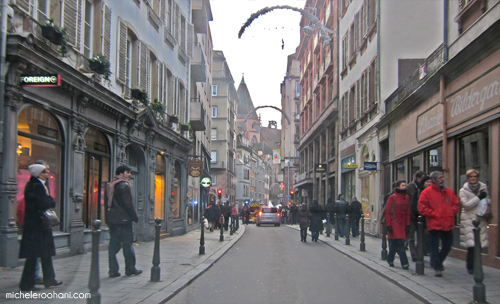
It was a very cold day but thousands of poeple were swarming the streets of this beautiful Alsatian city:
walking up and down narrow streets,
They have no pity for their babies fighting the cold,
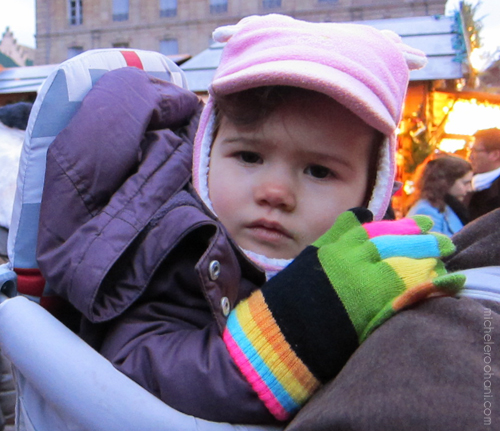
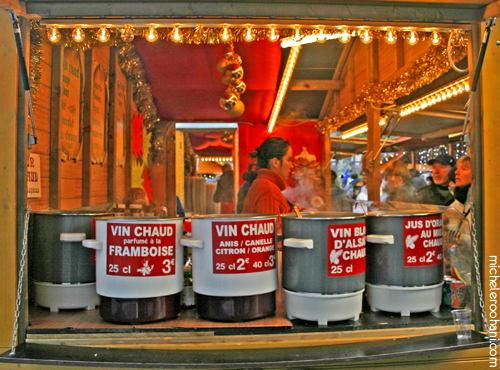
maybe because they drink this mulled wine called “Vin Chaud” (hot wine) or “Gluehwein” (in german): a concoction usually prepared from red wine, heated and spiced with cinnamon sticks, vanilla pods, cloves, citrus and sugar. They sell it in every other stand on the big Christmas market in Strasbourg:
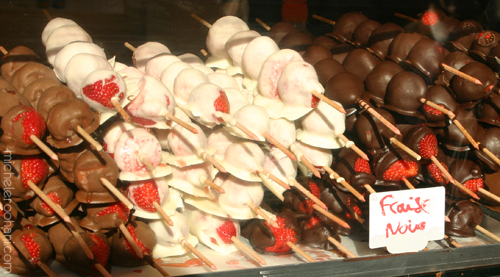
I saw my first chocolate covered “strawberry kababs”:
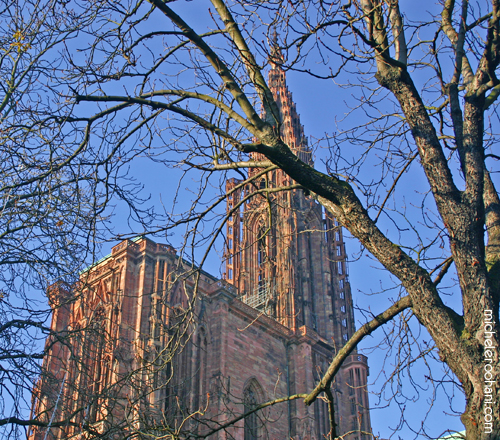
Strasbourg is home to one of the most beautiful cathedrals in Europe:
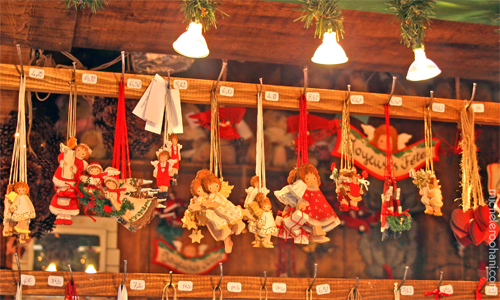
where Jesus’ birth will be celebrated this year with pomp and thousands of little ornaments made in Alsace (read China):
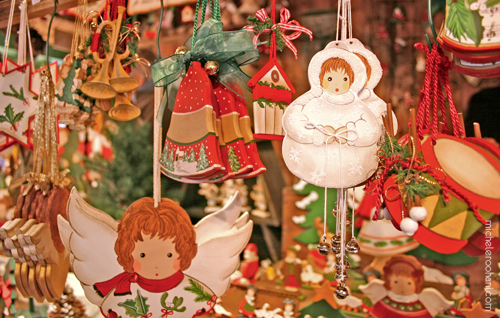
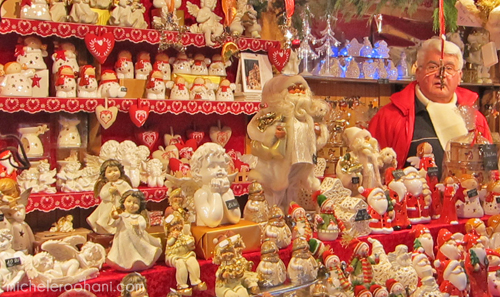
The market is not close to the big church but right at its feet with Santa Claus himself selling some of the stuff:
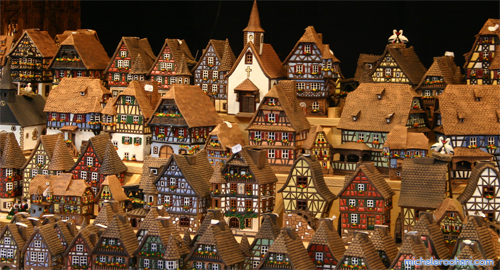
Here is Alsace in all its glory (albeit in miniature):
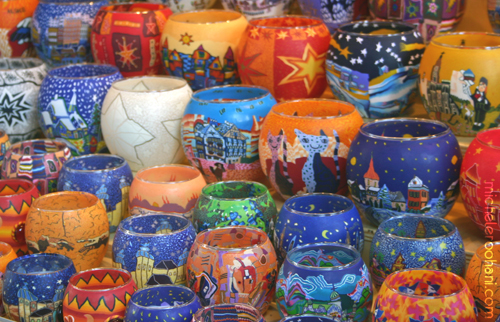
and colors,
with little chefs baking for the big birthday (Jesus’, remember?)
and big chefs of course making macaroons:
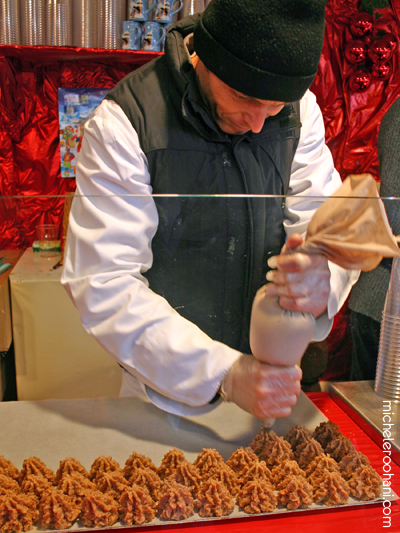
but for people with a weakness for great pastry I have a better treat:
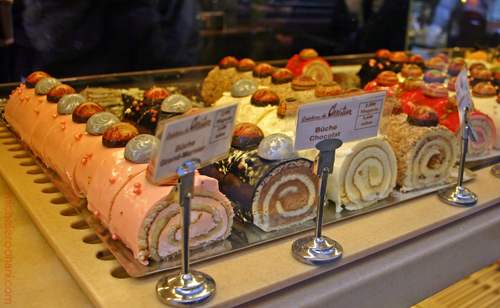
The above are Christmas Buches but Christian Patisserie—that I discovered a couple of years ago on my first trip to Alsace—is known for its chocolate:
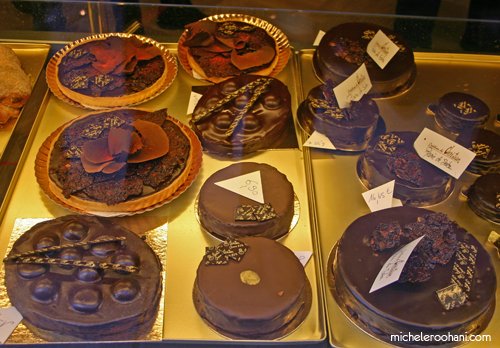
and anything related to it:
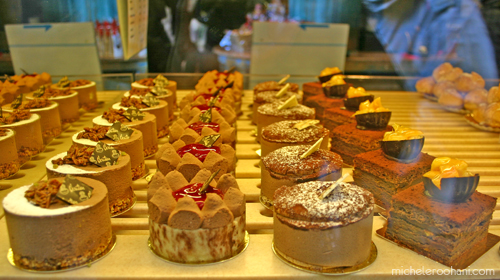
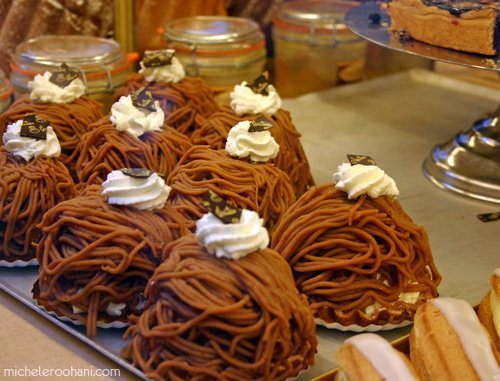
Chocolate not being on my repertoire much, I opted for the fabulous chestnut cream “Mont Blanc”:
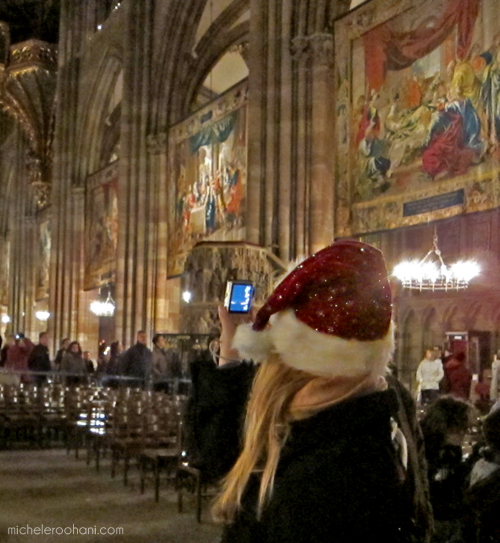
I went to the cathedral where a thousand Santas were busy clicking away on their cameras,
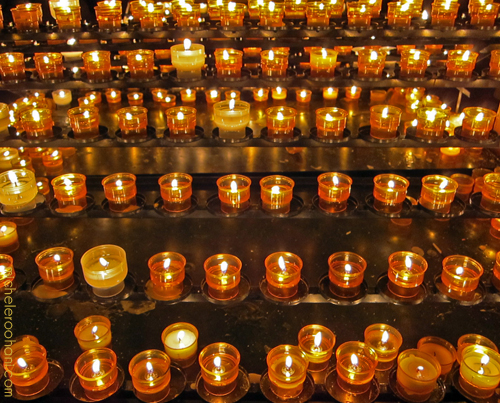
and a thousand candles promised to fulfill wishes…
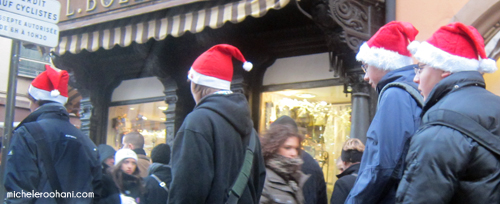
By the end of the day, I was one of the few without a red hat,
Alsace’s emblem is a stork—you see them everywhere:
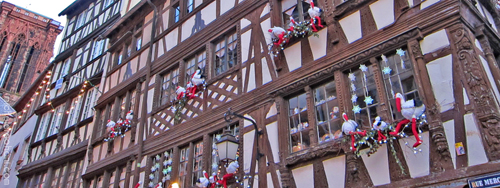
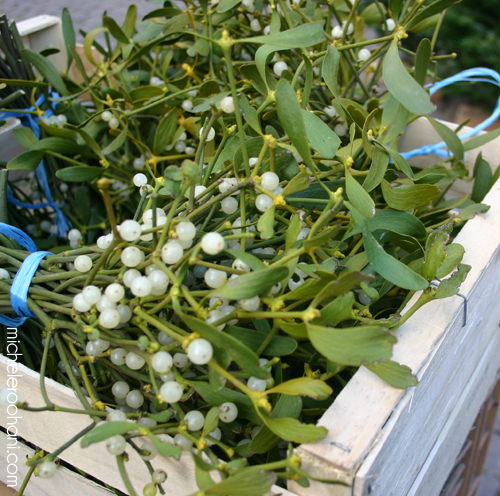
I couldn’t resist buying my first real mistletoe:
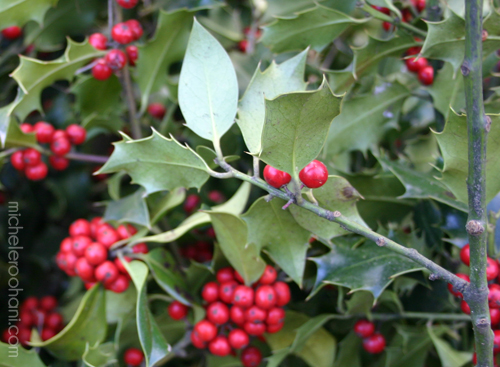
and looking at the holly,
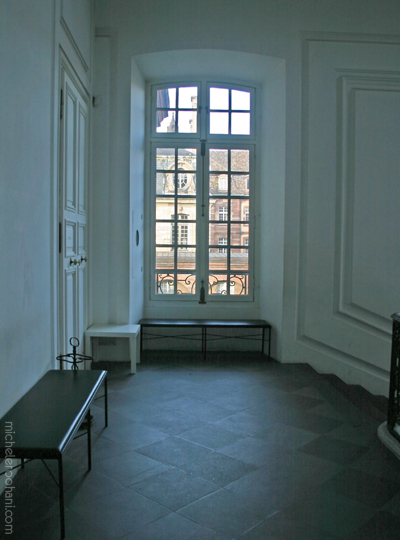
I went to see the Fine Arts Museum:
where I revisited “the beautiful woman from Strasbourg”:
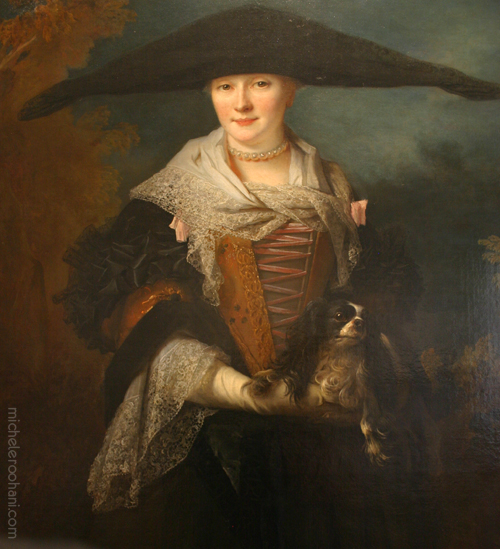
and the fabulous dutch still life paintings and my favorite Kessel insects of course:
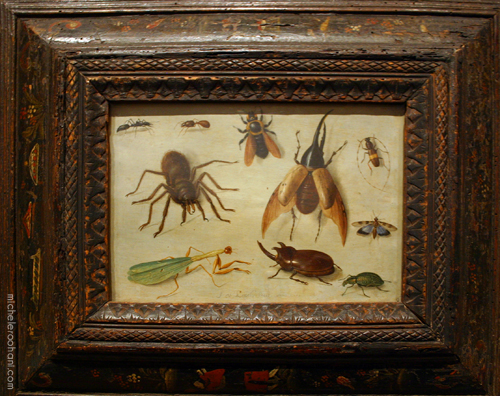
By the time I got out it was getting dark but the market was still hustling and bustling,
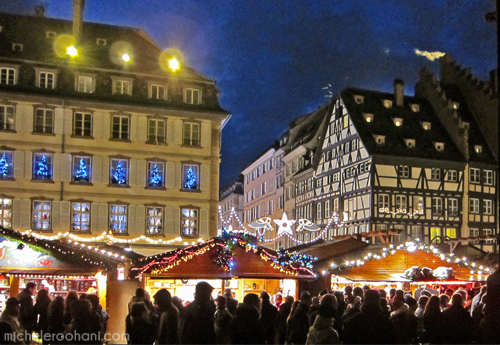
This whole trip almost made me forget Copenhagen’s climate summit, the American Health Bill disaster and the Swiss minarets…
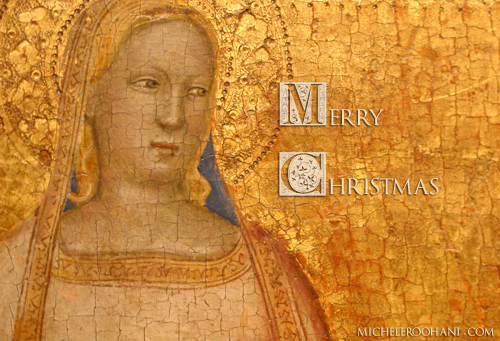
Have a golden Christmas everybody!
2010 World Cup Draw and the Group of Death
December 6th, 2009
The 2010 World Cup draw was two days ago and I watched it for the first time live on Swiss TV; I am a big soccer fan and it was exciting to see the world gasp waiting for the final draw in Cape Town.
There is as usual a group of death:
Group G
Brazil
North Korea
Ivory Coast
Portugal
where 3 of the 4 teams are known to have formidable soccer players.
These are my picks for the first round and yes I am brave enough to put my name on it!
The five time champion, Brazil, faces Portugal, Ivory Coast and North Korea in this very strong group G.
One of my most popular blog posts has been “Gerd Muller, where are you?” and I labored over these images of my favorite childhood soccer players like Muller himself:
and the prince, Beckenbauer, then and now:
“I don’t understand/like baseball and I tolerate American football only when my alma mater, USC, is playing but soccer stays close to my heart…There is a hierarchy of course like in any sport: we have princes and kings, Brazilian Gods and black pearls and panthers, even a black spider (the Russian Yashin)!
There is hand of God (Maradona) and real God (Pele):”
Jairzinho,
George Best,
the Charlton brothers,
Eusebio,
and last but not least, Michel Platini,
who would certainly give a red card to Thierry Henry after his handball disqualified the stunned Irish team at the qualifier match for the World cup which would be from June 11th through July 11th in South Africa.
To see my favorite post, “Gerd Muller, where are you?”, go here.
To see the full schedule on FIFA’s site go here.
How to distill complexity to minimum…
November 22nd, 2009
Between Hope and Chaos, 165 years of Iranian Photography
November 12th, 2009
The Quai Branly Museum presents the second PhotoQuai, the trendsetter biennial event dedicated to non-Western photography until November 22, 2009. Catch it if you can.
I was inspired to create this poster here and the clip at the end of the post:
Some of the images were breathtaking and I would like to share them with you.
The above image is from Abbas Kowsari; I call the next one by Gohar Dashti, “tea and tank”!
The Artistic Director of the Photoquai biennial is my friend, Anahita Ghabaian Etehadieh, Iranian founder and owner of the Silk Road Gallery, the only establishment in Iran dedicated exclusively to photography.
These two women were photgraphed by Bahman Jalali, one of the two curators of the exhibition:
More ambitious than the biennial itself, is the homage given to a sample of 165 years of Iranian photography, in the museum. It gives an overview of Iranian photography from the end of the 19th century, with the portraits from the Qajar era, up until the most contemporary works by major Iranian photographers. An uneven, discontinuous road full of great surprises…
The above photos were taken by Naser Al Din Shah himself, a photography enthusiast, and the following ones are by Armenian-Iranian photographer Antoine-Khan Sevruguin:
I love this shy Tar player:
The exhibition was especially interesting to me in its depth if not breadth of the older photos. I love these cute children photographed with their father in early 20th century peeking out of their hejab:
The exhibit spills into 20th century with masterpieces like Kaveh Golestan’s images of Iran Iraq war:
This visual storytelling will continue in the Musée de la Monnaie, museum of the French Mint and Treasury until December 20th. The exhibition is called “between Hope and Chaos” dedicated to 30 years of Iranian photojournalism, the three most recent generations of Iranian photographers between the 1979 Islamic Revolution and 2009.
I would look for my favorite works exhibited by Newsha Tavakolian:
I prefer this one that I got from her site—there is something otherworldly about Persepolis under snow…
Photoquai tries to highlight and promote artists unknown or little known in Europe encouraging cross-cultural dialogue across the globe.
A promenade along the Seine at quai Branly had been transformed into an open-air exhibition of photography where 50 photographers, chosen by the likes of Reza Deghati, the phenomenal Iranian photographer, exhibit their work.
Watch a great clip in TV5 here (even if you don’t speak french!)
165 years of Iranian photography here
PhotoQuai, Quai Branly Museum here
Iran, between Hope and Chaos here
Iran, United States’ best ally in the Tribal Belt Wars in Afghanistan
November 2nd, 2009
Iran may be United States’ best/only ally in the hellish war of the tribal belt region between Afghanistan and Pakistan.
An ignorant approach to the Afghan realities and the “benevolent negligence” regarding Pakistan will have more dire consequences for the U.S. and the schizophrenic government of Iran (saddled by Iraq and Afghanistan’s unrest on both sides) may be a necessary ally in the necessary war…The Islamic Republic will do anything to avoid facing up to the “enemy within” (aka millions of unhappy/angry Iranians)
Look at the map of the world’s most dangerous place; most of the 4,000,000 Pashtuns who live in the tribal belt between Afghanistan and Pakistan refuse to recognize the British-drawn Durand Line, which divides the two nations and splits families. Afghanistan, the fifth poorest country in the world with a life expectancy of 44 is deservedly called the “graveyard of empires”. It has been in a civil war in the past three decades.
The above picture, Exodus from Afghanistan, from the formidable photojournalist Reza Deghati has haunted me for years—the silence of this cold journey moves me deeply. I almost forget the picture was taken just twenty years ago; “Time” has indeed suspended its flight in this godforsaken country…
I met Reza in Paris last month at the opening of the exquisite exhibition (organized by my friend Anahita Ghabaian) of 165 year of Iranian Photography at the Quai Branly Museum. Stay tuned for next week’s post about PhotoQuai.
I was once again impressed by Reza, the great master photographer. We talked about his humanitarian work at Aina, a media & Culture center in Afghanistan. His extraordinary talent deserves a post all to itself—I became a fan years ago thanks to his National geographic’s photos like this one:
Only a few months ago, the Pakistani military was still inclined to view the Taliban as agents of influence able to provide their government with help to contain the Afghanistan in the west as it confronted India to the east. As Roger Cohen puts it: “the left hand doesn’t know what the right is doing—the result is self-amputation. Even Pakistan’s competent General Kayani, noted for his patience, diligence, intelligence and sheer determination, may be doing the wrong move in the right direction, too little too late.
Today’s news that Abdullah Abdullah has pulled out of the Afghanistan’s runoff election exasperated me even more; I can’t believe his official explanation for doing so but as Churchill says:
“in wartime, Truth is so precious that she should always be attended by a bodyguard of Lies”
and Afghanistan is deeply at war…
Take a look at Reza’s Webistan here.
Visit Aina here.
Visit the PhotQuai here. (click on “honoring Iranian Photography” to see some great photos)
Subscribe
Main
Home
About me
Contact
Art, ...


compositions
cities
flowers
objects
portraits
sepia tones
best sellers