My three Italian boy friends
February 23rd, 2010
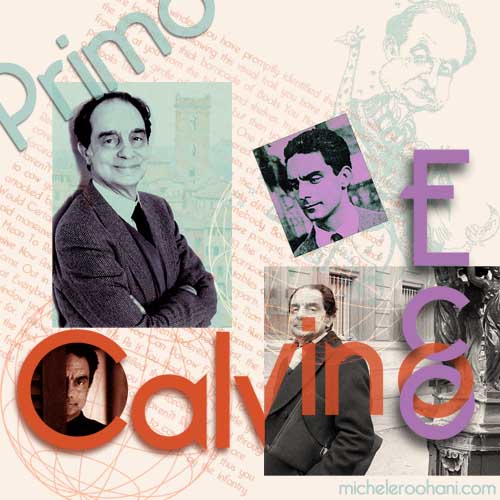
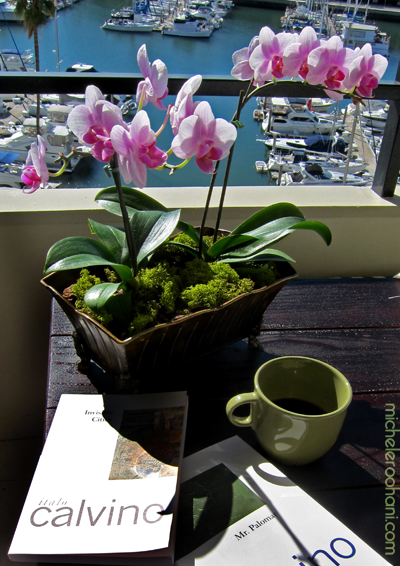
I was late for my rendez-vous with Italo Calvino but he didn’t get mad; time is after all an elastic commodity for Italians…
Seamus Heany talked to me at length about him and encouraged me not to despair but how could I? Calvino suddenly died before I got to know him.
Of the Italian Princes so far I only knew Umberto Eco and Primo Levi; I got to like Eco a lot after he took me to see the movie The name of the Rose about twenty years ago. Umberto and Primo each deserve their own blog post but let’s continue with Calvino.
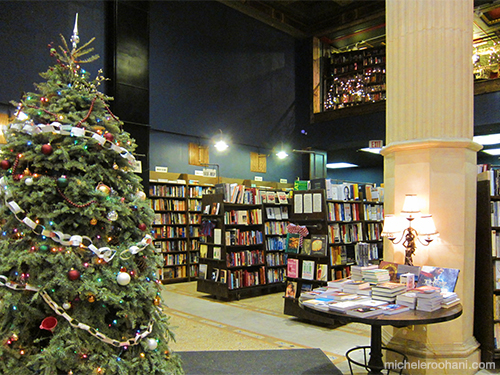
I liked so much what Calvino’s said about reading that I need to share it with you; read it and judge for yourself:
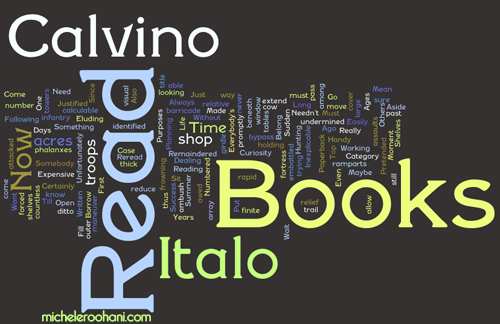
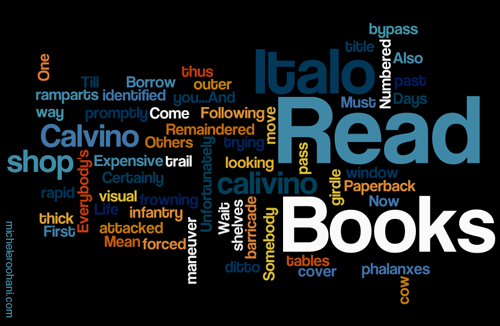
“In the shop window you have promptly identified the cover with the title you were looking for. Following this visual trail, you have forced your way through the shop past the thick barricade of Books You Haven’t Read, which are frowning at you from the tables and shelves, trying to cow you…And thus you pass the outer girdle of ramparts, but then you are attacked by the infantry of Books That If You Had More Than One Life You Would Certainly Also Read But Unfortunately Your Days Are Numbered. With a rapid maneuver you bypass them and move into the phalanxes of the Books You Mean To Read But There Are Others You Must Read First, the Books Too Expensive Now And You’ll Wait Till They’re Remaindered, the Books ditto When They Come Out in Paperback, Books You Can Borrow From Somebody, Books That Everybody’s Read So It’s As If You Had Read Them, Too. ”
The above image is that passage in wordle.
Gore Vidal wrote in 1985: “Europe regarded Calvino’s death as a calamity for culture.” and I agree. Italy is not just an operatic country with clowns like Berlusconi at its head…
A couple more quotes from Calvino:
“Novels as dull as dishwater, with the grease of random sentiments floating on top.”
“Only a certain prosaic solidity can give birth to creativity: fantasy is like jam; you have to spread it on a solid slice of bread. If not, it remains a shapeless thing, like jam, out of which you can’t make anything.”
Read about Calvino here
Vidal talking about him here
The lost and found Art of Bookbinding, a second anniversary issue
April 27th, 2009
It’s been two years since I started this blog and I just have to make this post fabulous…I’ve been wanting to write about the new Kindle for a while but I have felt guilty towards books!
As many of you know I am a shameless bibliophile but even though I am a rather “early adapter” of new technologies, buying a Kindle has not been a priority (you can carry a big chunk of your library—1500 books— and the neighborhood’s news stand in one Kindle).
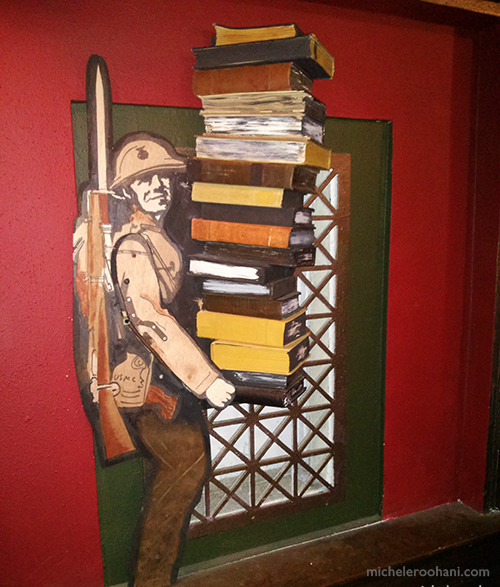
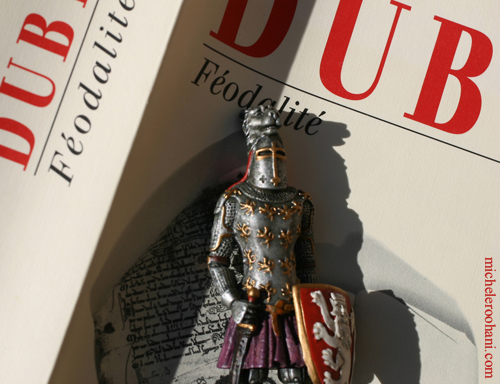
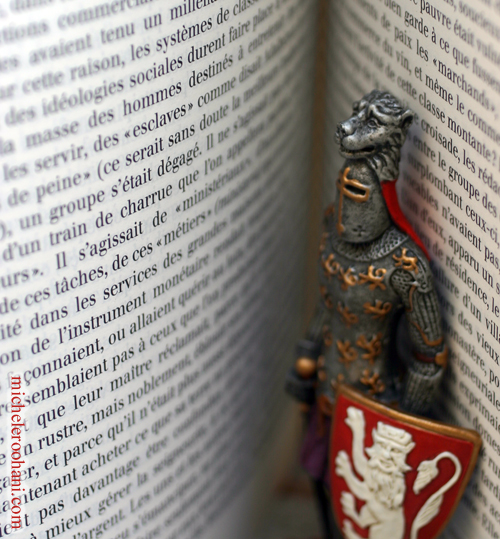
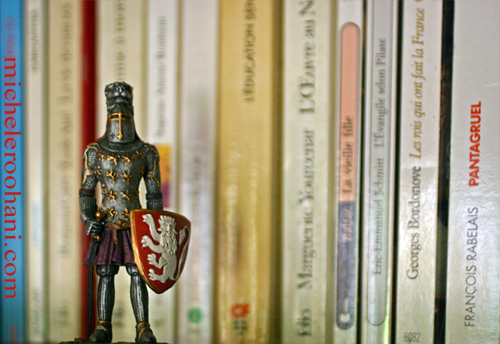
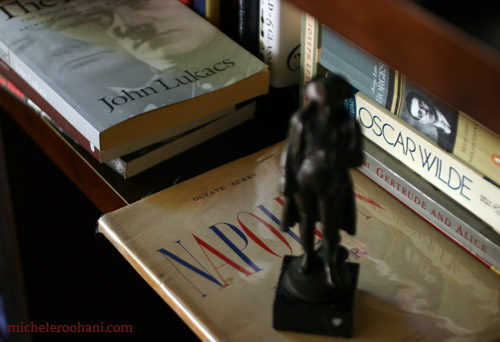
I am tactile and love touching books and feeling the pages, the type, smelling the paper, the ink, etc…this little soldier guards my books valiantly!
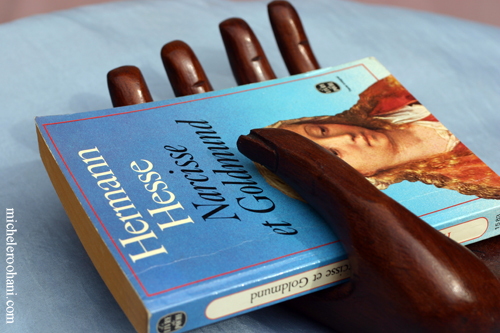
This one—Herman Hess’ Narcissus and Goldmund— was one of my favorites and I have read it in three languages during the past 30 years (talking about obsession!) and I can’t imagine getting the same pleasure from reading it on Kindle…
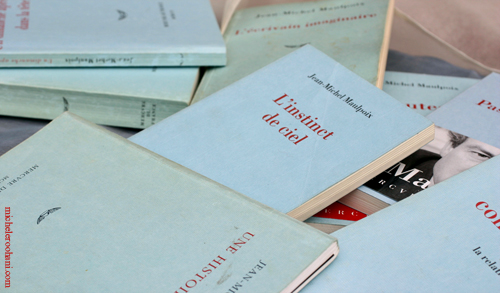
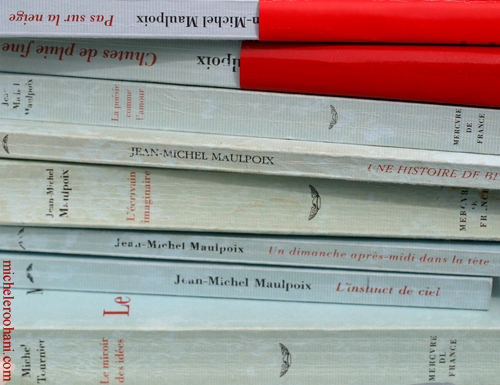
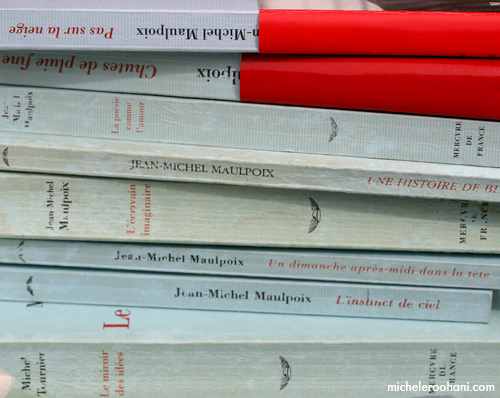
Could I have appreciated Jean Michel Maulpoix’s poetry without his signature blue covers? No paper?
Would he have wanted to be read on a gadget? Knowing him, I would say non!
“Blue makes no noise. It is a timid color, without ulterior motives, forewarning or plan; it does not leap out at the eye like yellow or red do, but rather draws it in, taming it little by little, letting it come unhurriedly, so that it sinks in and drowns in it, unaware.”
I can read Lukacs or Gopnick on a Kindle but not the Shahnameh (even writing about it is sacrilegious). One of my favorite blog posts is the one I wrote about this passion of mine.
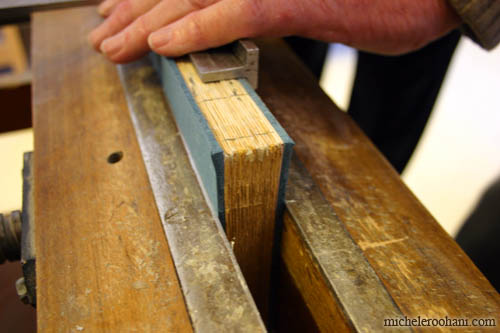
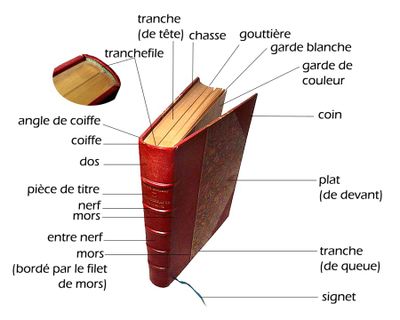
I audited a bookbinding course on my last trip to europe and was pleasantly surprised to see that this beautiful art is not dead.
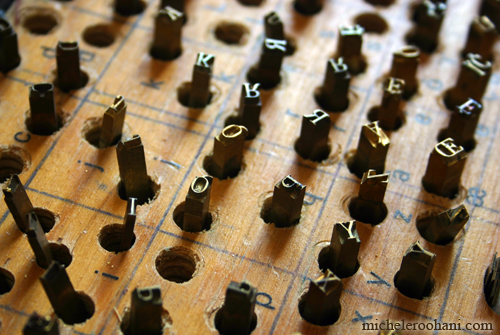
people in the atelier were restoring old books—resewing the pages, making new covers, etc—with a lot of love, attention and reverence. These fonts were for leather book jackets:
Is Amazon.com cannibalizing its own industry? They are the makers of Kindle.
I have to admit that even I would love to have all the newspapers I read daily, on one gadget. The gadget that carries most of my books to choose from on a trip; I guess all I am saying is that it’s very hard to read poetry on a machine—wouldn’t these beautiful poems feel/sound better on paper?
i do not know what it is about you that closes
and opens;only something in me understands
the voice of your eyes is deeper than all roses
nobody,not even the rain,has such small hands
e.e. cummings

“Parfois je me fais presque honte
De croire autant ce que je ne crois pas.
C’est une variété de rêve
Avec le réel au milieu.” Fernando Pessoa
Thank you all for the kind comments and support through these past two years.
Revisit my post on books here.
A book is a present we keep opening—again and again…
A night with George Steiner and Gaelle Boissonnard
January 26th, 2009
A night with George Steiner and Gaelle Boissonnard—now that’s a curious ménage! Late caffeine kept me up until 6:30 this morning and I spent the night with these two.
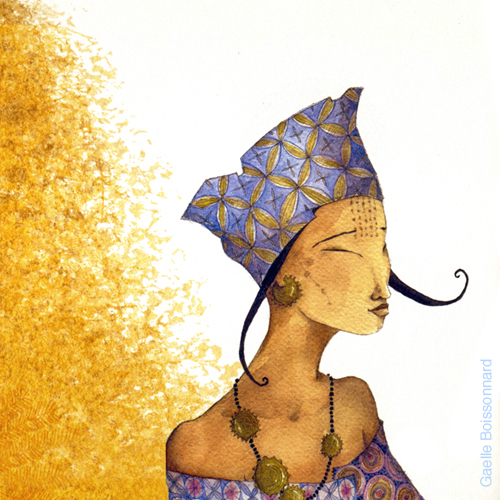
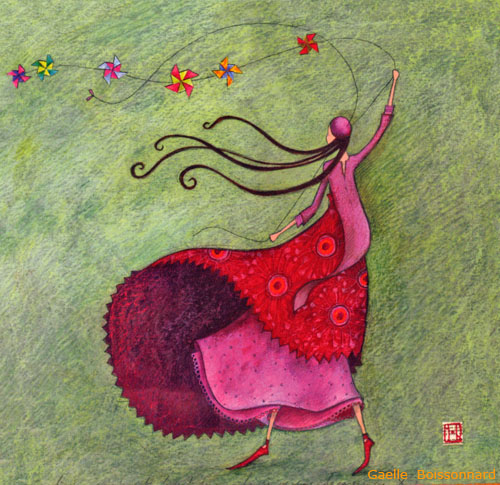
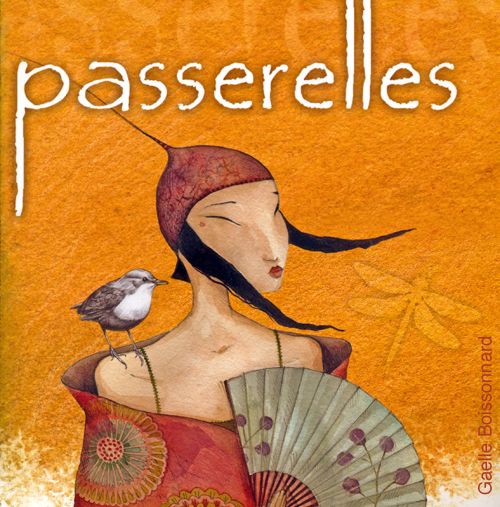
Steiner took me from an old Transfuge to wikiquotes and Cornel West; there goes 3 hours pf precious sleep and when my mind was too tired to absorb anything more, Boissonnard’s images were there to help with their delicate originality.
“There is something terribly wrong with a culture inebriated by noise and gregariousness.” Steiner
Boissonnard is everything our “noisy” culture isn’t—serene, quiet, tranquil…
She has started working with a new company; I hope this move makes her work more available to international markets. Just found out that my friends in Paris, La Banque de l’Image, mention her in their company’s blog!
I love this quote of Steiner: “the most important tribute any human being can pay to a poem or a piece of prose he or she really loves is to learn it by heart. Not by brain, by heart; the expression is vital.” This is what I have learned by heart long ago:
“Le tout est de tout dire, et je manque de mots
Et je manque de temps, et je manque d’audace
Je rêve et je dévide au hasard mes images
J’ai mal vécu, et mal appris à parler clair.” Eluard
دلم گرفته است
دلم گرفته است
به ايوان مي روم و انگشتانم را
بر پوست كشيده شب مي كشم
چراغهاي رابطه تاريكند
كسي مرا به آفتاب
معرفي نخواهد كرد
كسي مرا به ميهماني گنجشكها نخواهد برد
پرواز را به خاطر بسپار
پرنده مردني است
I feel sad,
I feel blue.
I go outside and rub my fingers
on the sleek shell of the night.
“I see that lights of contact are blocked,
All lights of contact are blocked.”
“Nobody will introduce me to the sun,
Nobody will take me to the gathering of doves.”
Keep the flight in mind,
The bird may die.
This post is in the loving memory of the 3 sisters my friend, Marie, has lost in the past few years (the last one two days ago)—all young, all from heart problems…
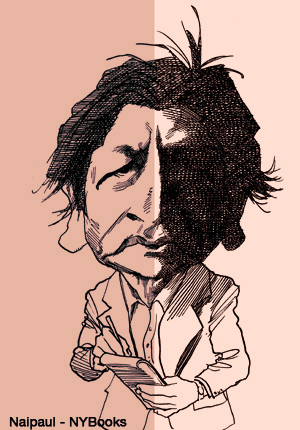
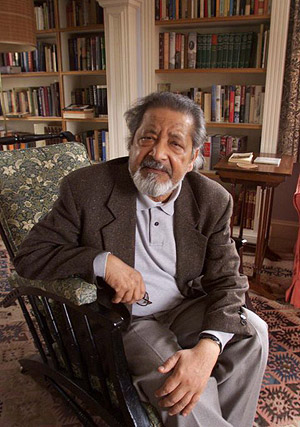
V.S. Naipaul, a monster I love?
December 23rd, 2008
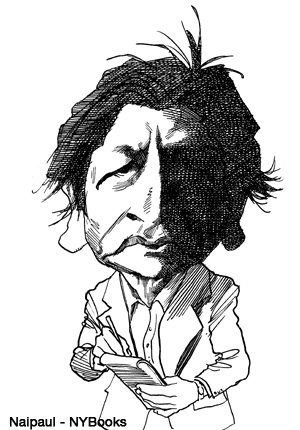
I’ve been reading this extremely entertaining book about V.S. Naipaul—The world is what it is—and realizing more and more how his anger towards banality, mediocrity and simple pettiness of people makes sense (of course he is obviously not a nice man). I have written about him before and my interest in him was sharpened after I read in the BBC about this biography of his being published without him changing a word of it. Now, that’s courage…
A good article about the book and the five years it took Patrick French to write it was published in The Nation ; a fascinating glimpse of the mind of the “supreme egotist”.
I find Naipaul’s banter with Derek Walcott amusing; read about it in The Telegraph.
Two Nobel Laureates from the West Indies fighting like children—cute!
Ian Buruma describes him well: “Naipaul’s voice, which some younger writers are tempted to mimic, cannot be defined by citing his opinions on race, the colonial experience, India, literature, or anything else. His views are frequently designed to shock and outrage.”
Cynicism (at its best) jumps at you from every page of French’s book and Sir Vidia’s lucid prose has kept me awake all last week. I empathize when he says: “my life is too short, I can’t listen to banality”.
Like Naipaul, I have refused to engage in wishful thinking all my life and if this makes me a cynic, be it! “The world is what it is; men who are nothing, who allow themselves to become nothing, have no place in it.”
added on 12/23/08—I keep looking for him—just read James Wood’s article, Wonder and Wounded: He is socially successful but deliberately friendless, an empire of one: “At school I had only admirers; I had no friends.”
added on 12/27/08—”Artists cannot claim immunity from decency.” Yasmin Alibhai-Brown
I agree to a certain point with her but I don’t believe that artists should be judged by their personality (ies)—Picasso must have been an impossible man with his lovers but I can’t deny his art…
Is Naipaul “mad, bad and dangerous to know” like Lord Byron was? Read this very good article in Times by Magnus Linklater.
Kertész and me: “on reading”
September 8th, 2008
I am a bibliophile and not ashamed to admit it! I love good books, and as much as I read online, paper and ink remain sacred to me. My love for books is thanks to my father’s great library of classics.
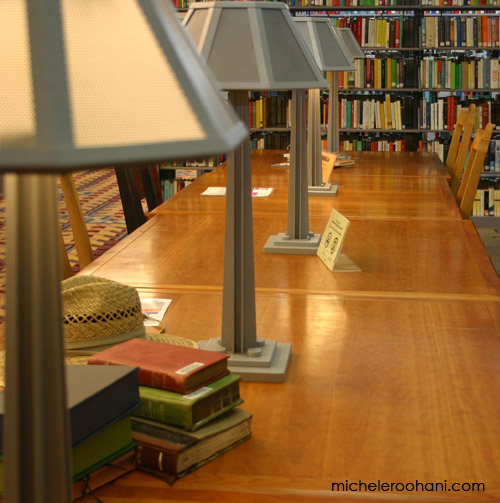
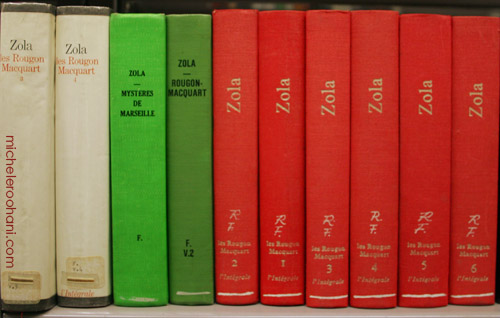
I went to the Los Angeles Central Library looking for some books and I couldn’t resist taking these pictures and sharing them with you. This library burnt in 1986—something about burning books fills me up with utter sadness and an enormous sense of loss (remember Fahrenheit 451?)
To see the most beautiful libraries of the world visit this site. We need these in a world where “print” increasingly resembles an endangered species.
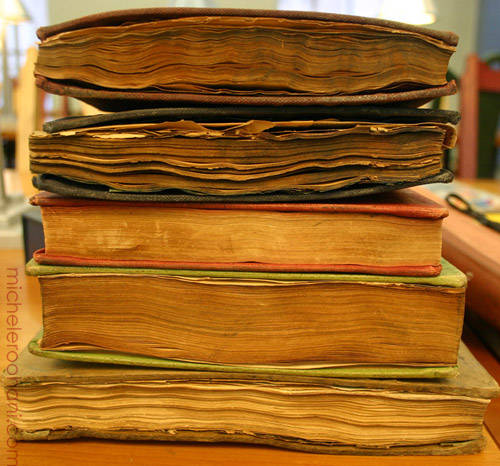
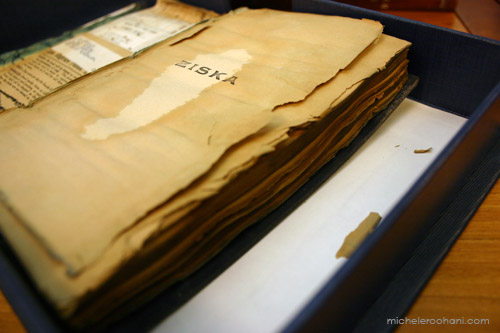
The books that were somewhat burnt yet still salvageable are so fragile that they have to be kept in special boxes. You can still see the black soot on them:
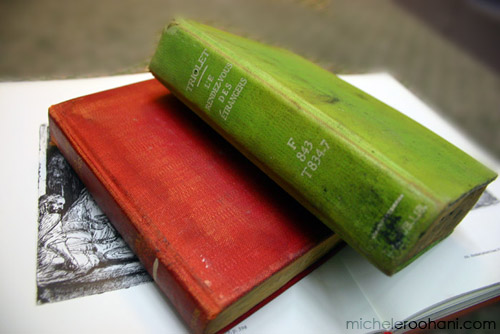
You can’t check out the more damaged ones because of their fragility like this one:
The good news is that there are thousands of wonderful and “healthy” books in this library and the reading rooms are very pleasant.
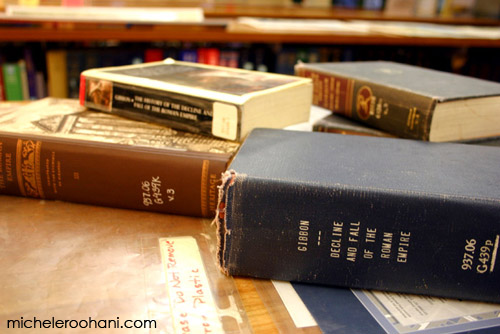
This is one book I have promised myself to read one day:
But who has the courage to even contemplate these ones:
André Kertész’s newly reissued photo essay “On Reading“, features 66 images, taken between 1915 and 1970, of people enraptured by print.
“Kertész’s images celebrate the power and pleasure of this solitary activity and capture the deeply personal, yet universal moment of reading. This poetic book that has long been out of print is even more compelling today in a world where “print” increasingly resembles an endangered species.”
Even if Jeff Gomez argues that we are at a Gutenbergian moment, in which writers, publishers and readers must make the jump from paper to the more fluid territory of the screen, I can’t imagine being without the smell and the feel of paper.
I still print everything serious that I want to read because staring at my screen bothers my eyes.
“Books won’t stay banned. They won’t burn. Ideas won’t go to jail. In the long run of history, the censor and the inquisitor have always lost. The only sure weapon against bad ideas is better ideas.” Alfred Whitney
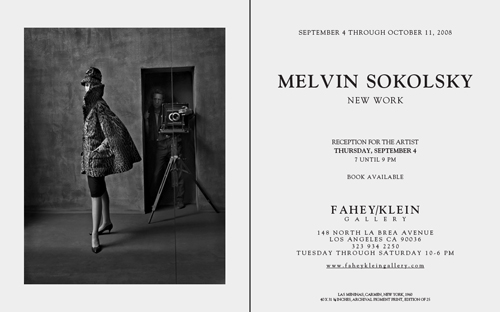
Speaking of great photographers, I went to Melvin Sokolsky’s opening night last thursday at Fahey/Klein Gallery. I’ve had the privilege of taking a “Master Class” at UCLA with him some years ago. His pictures have remained as fresh as the day he took them and unbruised by time.
A Persian in Venice
June 2nd, 2008
My smile got bigger and bigger as I continued listening to Professor Riccardo Zipoli talking about Iran in his near perfect Persian; but then I got a bit frustrated remembering that in spite of speaking three languages myself, I have to applaud every non-Persian who can say 4 words in my mother tongue! Listen to him talk here to see what I mean by Zipoli’s flawless Persian.
These two pictures are from the Professor’s huge archive. He has a soft spot for the rural landscape/people of Iran.
Born near Florence, teaching in Venice, reciting Sohrab Sepehri better than most of the natives has endeared Zipoli to Persians. I particularly like his Tree series. You can find more of his pictures on his site.
Looking at these images made me nostalgic so I went to look for some pictures from my last trip to Iran about 14 years ago. Here is one of my favorites from the Shah’s Mosque in Isfahan, a marvel of Safavid art. I still remember my awe in front of all these magnificent architectural wonders.
“If you come to visit me
Come gently and slowly lest the fragile china
Of my solitude cracks”
به سراغ من اگر ميآييد،
نرم و آهسته بياييد، مبادا كه ترك بردارد
چيني نازك تنهايي من
“Si vous venez m’y chercher,
Venez-vous-en donc lentement et doucement
De crainte que ne se raye
La porcelaine de ma solitude.” Sohrab Sepehri
And for all of you people who are still looking for a Persian in Venice, I am sharing this picture I took some years ago.
Claude Verlinde and Jacques Poirier, mirage makers.
April 27th, 2008
Claude Verlinde and Jacques Poirier are two underrepresented French painters. They are both master illusionists/image makers/mirage makers.
I fell in love with the above painting when I first got introduced to Verlinde’s work in Paris. We all know hollow people, lacking in real value, sincerity, or substance – we have all met shallow people lacking in depth of thought, or feeling. In Persian we call them “hollow drums”: noisy but empty.
Thanks to the internet we can know of something without really knowing about it. We used to have to read, to see, to hear something in order to be able to talk about it but not anymore folks! everybody’s an expert.
I’ve been wanting to talk about V.S. Naipaul for the longest time. Every time that somebody tries to eat up my life/time, I remember the writer’s fabulous statement reported on BBC: “my life is too short, I can’t listen to banality”.
Staying with the trompe l’oeil of Verlinde and Poirier, take a look at this very clever ad:
You can see the rest of these very funny ads here.
Today is my blog’s first anniversary! If you like what you see, please subscribe.
All these unworthy opinions…
March 3rd, 2008
Check your facts people! Until a few years ago, being judgmental was politically incorrect (a very tired notion today) but as I am growing older, I am realizing that Life is too short not to judge. My good friends André Démir and Tamas Ungvari are “Messrs Opinion” both; in these times of “chilling apathy”, it’s refreshing to see somebody take a stand on something (in their case, on everything). This post is an homage to these two gentlemen, both hungry observers of the life around them and armed by an uncanny fluidity of intelligence.
I get frustrated when I hear all these unworthy opinions rolling out of everybody’s mouth; it’s good to check our facts before sharing them with everybody. Trust but verify. I am ready to listen then but I can’t even count the number of times that somebody has recited an article from a major newspaper or repeated a pundit’s interpretation of the news as an absolute fact to me. I am not completely innocent myself.
My hero, Isaiah Berlin, believed in “the power of the wisely directed intellect to illuminate, without undue solemnity or needless obscurity, the ultimate moral questions that face mankind”.
You just have to watch TV a bit to see how this power is misused by the kinds of the anchormen at the Fox News (or CNN for that matter). Beside making me sick, Ann Coulter makes me doubt Berlin’s philosophy:
‘Life can be seen through
many windows,
none of them necessarily
clear or opaque,
less or more distorting
than any of the others.’
I would have loved to listen in to Berlin and Akhmatova’s conversation in a fateful night in 1945.
There is so much going on in the world with the renegade Kosovo, the two-headed Russia and Ahmadinejad in Iraq but those should wait another post to exploit your patience – I’ll try to make the next one all about flowers and butterflies.
Coming to life with an iPod
November 5th, 2007
I love my iPod! It’s ancient but I don’t want to get a new one yet; I have to admit that having a portable music library has not been my primary concern but the podcasts…oh the podcasts…

Many of my friends have asked about subscribing to podcasts with an iPod (or any other MP3) – this is how I listen to my news from around the world – it’s like TiVo-ing your favorite radio shows; you have to install itunes and take it from there:
1) if you don’t already have itunes download it for free at http://www.apple.com/itunes/download/
2) install it
3) go to itune store/podcast http://www.apple.com/itunes
4)search for shows you like halfway through the screen:

And the rest is pretty easy. Here are some of the things I listen to: NPR morning news, scientific american , slate magazine, 2000 ans d’histoire, in our time with melvyn bragg, Radio Lab, NYT’s Frank Rich/Maureen Dowd , etc… I do download a “medley” of different stuff and I hardly listen to music on my ipod but that’s just me – the beauty of it all is that I can listen to what I want when I want and with a little gadget (iTrip), it even plays on my car radio.

Five minutes in the morning to download the podcasts from my computer and this can carry me through Life’s rush-hour…Happiness is a lot of small/little things.
I am in favor of kindness and you prefer concentration camps
October 9th, 2007
Isaiah Berlin was a political philosopher and historian of ideas. He remains a hero to me.

one of the greatest minds of the twentieth century, he remained true to his humanity. “I came to the conclusion that there is a plurality of ideals, as there is a plurality of cultures and of temperaments. I am not a relativist; I do not say “I like my coffee with milk and you like it without; I am in favor of kindness and you prefer concentration camps” — each of us with his own values, which cannot be overcome or integrated. This I believe to be false. But I do believe that there is a plurality of values which men can and do seek, and that these values differ.”
Subscribe
Main
Home
About me
Contact
Art, ...


compositions
cities
flowers
objects
portraits
sepia tones
best sellers